 Loading... Please wait...
Categories
 New Products
-


-
 $10.00
-
 $10.00
-
 $10.00
-
 $10.00
Our Newsletter
- Home
- Lmtd/Opn Edtns ~ 40% Off~ Free Shipping
- "Marge" & "Pudgy" by Lonnie Ortega ~ 40% Off ~ Free Shipping
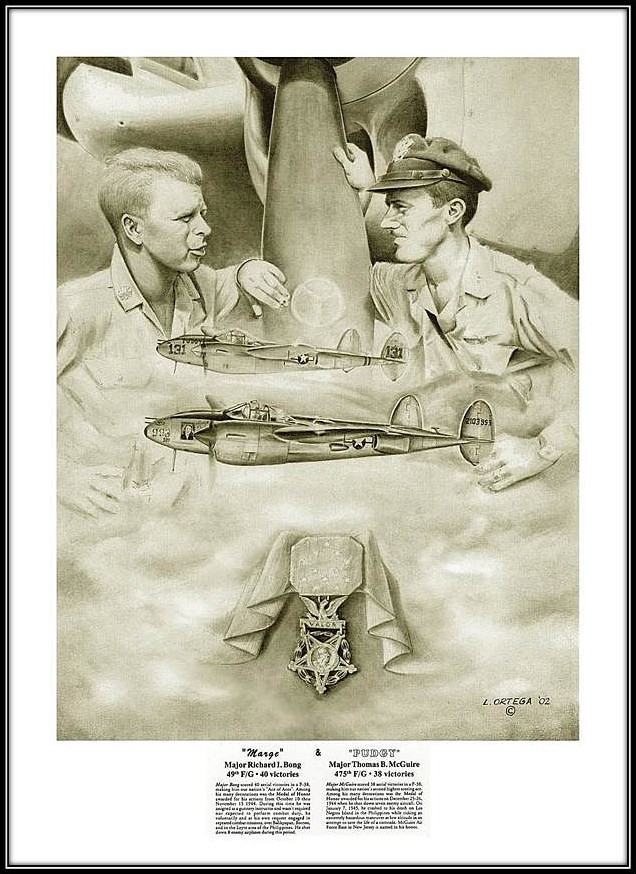
"Marge" & "Pudgy" by Lonnie Ortega ~ 40% Off ~ Free Shipping


RRP:
Your Price:
$21.00
(You save $14.00)
SKU:
13 L/E LO
Weight:
0.00 LBS
Rating:
 (
1 product review
)
(
1 product review
)
Shipping:
Free Shipping
Product Description
Print Size: 12"x 16.75" ~ a duo-tone 375 L/E print signed by: the Artist. Comes with a COA.
"Marge" & "Pudgy"The first of nine children, born in 1920 to a Swedish immigrant father and American-born mother, Dick Bong's upbringing epitomized the values and expectations of that era - loyalty to his family and a deep sense of patriotism. Like all farm children, he had chores to perform and was expected to drive farm machinery at an early age. He hunted and fished in the surrounding woods and streams, played on his school athletic teams and sang in his church choir; as his 4H project he planted the extensive evergreen windbreak on the family farm, still in the family. At that time he modeled the ideal all-American boy. Dick became enamored of flying as a small boy, watching planes fly over the farm carrying mail for President Calvin Coolidge's summer White House in Superior. As a college student he learned to fly in the Civilian Pilot Training program; at the age of 20 he became a flying cadet in the US Army Air Corps, in time for the entry of America into World War II. Dick became America's all-time Ace of Aces, downing 40 enemy planes in the Pacific theater of the war while flying P-38 fighter planes. His many decorations for outstanding skills and extraordinary courage included the Congressional Medal of Honor. Dick was ordered home for his safety and married his sweetheart, Marge, in Superior. Six months later he was killed test piloting the first Lockheed jet fighter plane. His death at the age of 24 occurred the same day that the atomic bomb was dropped on Hiroshima, yet he received banner headlines in the national newspapers. Thousands attended Dick's funeral services in Superior, and many more lined the funeral route to the Poplar cemetery, where he was buried in the family plot. In 1955, ten years after his death, a memorial was dedicated to Dick Bong in his hometown of Poplar, Wisconsin.
Major Thomas B. McGuire
America's 2nd highest Ace (38 victories)
Born on August 1, 1920 at Ridgewood, New Jersey, he grew up there and in Sebring, Florida. He graduated from the Georgia Institute of Technology in 1941 and enlisted in the Army Air Corps, completing his aviation training and received promotion to Captain early in 1942. After service in the United States and Alaska he was ordered in March 1943 to the 49th Fighter Group of the 5th United States Air Force, then operating in the Southwest Pacific Area and in particular providing an early air screen for Darwin and Northern Australia. Subsequently he was transferred to the 475th Fighter Group, 13th Air Force, where he won promotion to Major. He was already a leading ace with a record of 31 Japanese planes shot down when he volunteered on December 5, 1944 to lead a squadron of P-38s on a bomber escort mission over Mabalacar Airdrome on Luzon, Philippines. He shot down 3 of 20 Japanese Zero fighters that attacked his squadron. The next day, on a similar mission over Clark Field, near Manila, he exposed himself in order to draw fire away from a crippled bomber and shot down 3 of the 4 fighters that were attacking it. Another score on his way home that day brought his total to 38. On January 7, 1945, while leading a flight of four P-38s over Los Negros Island, he attempted a highly-dangerous maneuver in order to aid a comrade who was losing an encounter with a Japanese Zero and crashed. He was posthumously awarded the Medal of Honor in March 1946 for his actions on December 25-26, 1944 and January 7, 1945. His score of 38 enemy kills made him the second leading American fighter pilot of World War II, following Major Richard Bong. McGuire Air Force Base in his home state of New Jersey was named in his honor.

Product Reviews
-
Very good, but could be better
Posted by Michael T. Terry on 6th Jan 2014
Ortega has done a good job on this piece, which is based on the iconic photograph of Bong and McGuire talking in front of a P-38 prop blade. There are two reasons I could not give it a perfect five stars: first, he shows just 12 stars on the Medal of Honor instead of 13, and his write up on McGuire notes that Mac went down over Los Negros -- it was actually Negros. In Ortega's defense on this point, however, even the MoH citation got the island wrong.